


For most first-time visitors, the best way to experience Cappadocia’s underground cities is to choose one, understand the visitor route, and give it a place in your day that does not feel rushed. Derinkuyu and Kaymaklı are two options to compare, but the most useful decision is not simply which sounds larger or deeper. Consider the actual access, the itinerary around the visit, and how comfortable you are in enclosed spaces.
These are historic underground settlements, not modern museum buildings with uniformly spacious galleries. Their chambers and connecting passages are part of what makes them interesting, but also what requires thought before visiting. Do not assume that a tour description mentioning an underground city guarantees a particular site, a particular number of open levels, or a route suitable for everyone.
This guide focuses on choosing and preparing for a visit. It keeps practical questions separate from dramatic claims about ancient populations, hidden tunnels, and record-breaking depth.
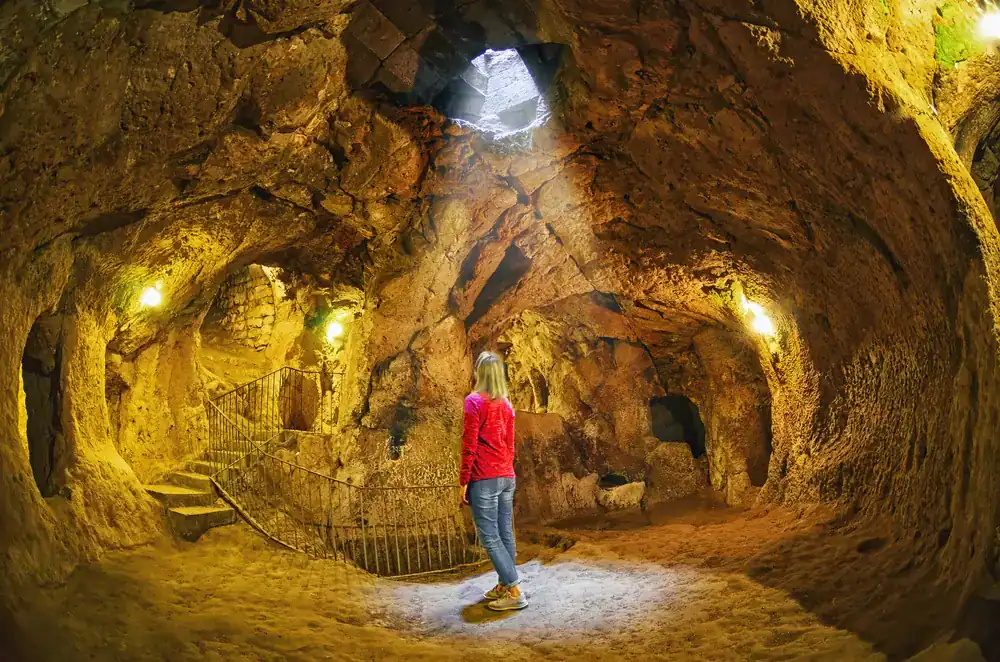
What makes an underground-city visit different?
The interest lies in how a connected underground environment was organized: moving between spaces, storing supplies, managing access, and supporting life below the surface. Looking only for the deepest point can distract from the details that make a visit meaningful.
At Derinkuyu, the official museum description identifies storage, ventilation, religious spaces, and large stone closures. It also notes that some connecting tunnels allow only one person through at a time. The description refers to an eight-level structure; that is not a promise that every level is open during your visit.
The official Kaymaklı museum page describes rooms and halls connected by narrow corridors, with spaces associated with food storage, kitchens, water, ventilation, and religious use. It refers to four illuminated visitor levels within a larger complex. Check the current route before visiting rather than treating a descriptive page as a guarantee that every area will be accessible on your date.
You do not need an elaborate historical theory to appreciate either site. Ask how a particular space was used, what evidence supports that interpretation, and which features belong to the permitted visitor route. A good explanation should help you notice what is in front of you rather than rely entirely on impressive numbers.
Derinkuyu versus Kaymaklı: choose using practical questions
Both names appear frequently in travel planning, and either may be offered as the underground stop on a wider itinerary. Instead of choosing from a single superlative, compare the information available for the actual visit you are considering.
| Derinkuyu: what the official description establishes | Kaymaklı: what the official description establishes |
|---|---|
| An eight-level underground structure. This does not establish that all eight levels are open to visitors. | Four illuminated visitor levels described within a larger complex. Recheck the route available on your date. |
| Some connecting tunnels are only wide enough for one person. | Rooms and halls are linked by narrow corridors. |
| Features include storage and religious spaces, ventilation, and stone closures. | Features include food and water storage, kitchens, ventilation, and religious spaces. |
The level counts describe different things: the overall structure at one site and illuminated visitor levels at the other. They are not a like-for-like ranking of size, access, or difficulty. Neither description justifies calling a city suitable for every traveler.
Choose Derinkuyu when it is the site you specifically want
If you have read about Derinkuyu and it is a central reason for your trip, make that preference explicit before booking. Ask whether it is confirmed or merely one possible stop. Do not assume a substitute will satisfy you simply because it is another underground city.
Choose Kaymaklı when it matches your confirmed itinerary
Kaymaklı is a sensible choice when it is the named site on an itinerary you otherwise prefer. You do not need to visit another city immediately afterward to make the experience complete. Consider what the rest of the day offers and whether its pace suits you.
Avoid choosing it solely because someone called it the easy alternative. Your comfort depends on the specific route and your own needs. Request concrete details rather than relying on a broad comparison made by a traveler with different expectations.
If you have no strong preference, prioritize the whole visit
Choose the arrangement with the clearest information, appropriate pacing, and an itinerary that makes sense for your interests. A well-explained visit to one site is usually more useful than rushing through both without time to understand either.
If your interest is more specialized, visiting both can have a purpose. Ask a guide to help you compare layout and functions rather than repeating the same general introduction twice. Give each visit enough room in the schedule and consider whether consecutive underground visits are how you want to spend the day.
What to find out about the visitor route
Before deciding whether a visit suits you, ask how the public route works from entrance to exit. The answer matters more than a headline depth or the total number of rooms associated with the site.
Useful questions include whether the route uses steps, where visitors need to bend, how long the narrow sections are, and whether traffic is managed in a particular direction. Ask whether there is any permitted shorter option and how someone who chooses not to continue should proceed. Do not assume that turning around is straightforward in every passage.
A tour provider may have general experience with the site, while museum staff can clarify current restrictions. If your decision depends on a specific access detail, ask that question directly and close to your visit date. An old traveler photograph may not show the route currently in use.
Allow the pace of the route to determine when you stop. A place that is interesting for a photograph may also be a point where other visitors need to pass. Save longer questions for an appropriate open area rather than stopping a group in a narrow connection.
Follow current signs, barriers, and staff instructions. The existence of a passage does not mean visitors are allowed to enter it. Do not use an online map or a social-media clip as permission to explore beyond the marked route.
Use three questions to follow the explanation
First, ask what a space was for. A room becomes more memorable when you understand its proposed function rather than only its name. Second, ask how it connects to the surrounding spaces. Thinking about movement helps you follow the layout instead of remembering a series of disconnected chambers.
Third, ask how the interpretation was reached. Which visible features support the explanation, and where is the answer less certain? This keeps the visit grounded in evidence without requiring you to arrive with specialist knowledge. It also gives a guide a chance to distinguish a well-supported observation from a popular story.
You might remember one storage area, one connecting passage, and one question afterward. That is a more useful record than collecting numbers about depth without understanding what the place reveals.
Think honestly about enclosed spaces and access needs
An underground-city visit should be a choice, not a test of determination. If enclosed spaces make you uncomfortable, or if bending, climbing, and uneven surfaces are difficult, collect specific information before committing. A companion’s enthusiasm does not answer those questions for you.
Tell the museum or provider what you need to understand. For example, asking whether there are sections that require sustained bending is clearer than asking whether the visit is difficult. Asking how exits are reached is more useful than asking whether you can simply leave whenever you like.
For travelers with mobility requirements
Do not assume that a general admission ticket or an accessible vehicle means the interior route meets your needs. Ask separately about the entrance, visitor route, steps, passage dimensions where relevant, available assistance, and any permitted alternative. Request enough detail to make your own informed choice.
If a particular access requirement is essential, have it acknowledged before booking. A last-minute discovery at the entrance may be harder to accommodate, especially on a group itinerary with several other stops. Avoid relying on an unsupported promise that everyone manages it.
For travelers concerned about confined spaces
Ask for a realistic description rather than reassurance alone. You may want to know where narrow sections occur, whether visitors wait in them, and what options exist if you decide not to enter. This guide cannot determine whether the environment is appropriate for your health or personal circumstances.
Choose an aboveground alternative if that is the better fit. You can still have a rewarding Cappadocia visit focused on other cultural sites and landscapes. Skipping one kind of attraction does not make the trip incomplete.
For families and groups with different needs
Discuss the plan before arriving. Consider whether everyone wants to enter, who will stay with anyone opting out, and where the group will meet afterward. Ask the provider how a split group would work and whether it changes the price or schedule.
Do not assume that a stroller can follow the interior route or that a child will react the same way underground as in an open-air museum. Ask about current visitor rules and practical arrangements. Make the decision based on the people traveling, not on a generic age-based recommendation from an unrelated itinerary.
Should you visit with a guide or independently?
A guided visit can help connect the individual spaces into an understandable story. It can also reduce the amount of transport and schedule planning you need to do. Check whether a guide accompanies the underground visit itself, what language is used, and how much interpretation is included.
An independent visit may suit travelers who prefer to set their own pace and arrange transport themselves. That freedom still depends on the museum’s visitor route and rules. Plan the return journey as carefully as the outbound trip, and avoid relying on an unconfirmed pickup when you have another fixed commitment later.
When comparing options, separate admission from transportation and guiding. A low advertised amount may cover a different combination of services from another quote. Ask whether the ticket is included, whether it is purchased separately, and what happens if the intended site cannot be visited.
Check which city a Green Tour includes
Sky Quest Travel’s Green Tour description names Derinkuyu or Kaymaklı for the underground-city stop. Confirm which is planned for your date. Do not read the alternatives as a promise that the tour enters both museums.
If the specific city is important, ask whether it is guaranteed in your confirmed itinerary or could change. Also check the other stops and walking expectations. The best choice for you depends on the complete day, not only the underground portion.
For help comparing the broader sightseeing formats, see our Red Tour and Green Tour guide. Use that comparison to understand the different interests a day can serve, then verify the current service details before booking.
Give the underground visit enough space in your day
Do not plan the day by adding only the time you expect to spend inside. Transportation, admission arrangements, meeting the guide, getting ready, and regrouping afterward all take time. The actual visit may also move at the pace of other visitors and the current route.
If you are joining an organized tour, let its confirmed sequence determine the day instead of booking separate activities against an optimistic return estimate. Tell the provider about any onward flight, transfer, or nonflexible reservation before paying.
If you are traveling independently, choose nearby or logically grouped stops rather than crossing the region repeatedly. Allow room for a meal and a break after the visit. You may prefer some open-air time rather than immediately entering another enclosed attraction.
A morning balloon outing and an underground visit are not automatically incompatible, but their complete schedules and physical demands need consideration. Confirm timing with the providers and decide whether the combination suits your preferred pace. Being able to fit two activities on paper does not oblige you to do both.
What to prepare before you go
Keep your belongings manageable and your hands available for moving through the permitted route. Choose footwear appropriate for steps and uneven surfaces, and avoid carrying more than you need. Ask in advance if you have bulky equipment, luggage, or an item whose admission might be restricted.
Check the day’s broader weather and dress for the full outing, including time outdoors before and after the underground section. A removable layer can be practical, but do not assume that every part of the itinerary has the same conditions. Avoid choosing clothing that makes bending or movement awkward.
Before entering, find out where your group will meet afterward and how to contact the guide if you become separated. Keep the meeting instructions accessible without depending entirely on a mobile connection. Use available facilities when appropriate rather than assuming they exist at every stage of the interior visit.
For photography, ask about current rules and be considerate with equipment. Do not block movement to adjust a tripod, set up a portrait, or repeat a shot. A small number of thoughtful images is more useful than a recording process that distracts you from the place.
Choose one observation to discuss afterward. For a storage space, ask what evidence identifies its use. For a ventilation feature, ask how its role fits the surrounding layout. For a closure, ask how it relates to movement between spaces. Treat these as questions for interpretation rather than answers you can reliably infer from appearance alone.
If you enjoy keeping travel notes, write a few lines after leaving rather than trying to record everything while moving through the route. Note the feature, the explanation you heard, and anything you want to read about later. This creates a useful memory without distracting you during the visit.
Tickets, opening hours, and passes: check close to the visit
Use the official museum pages for current opening information and contact details. Check both closing time and ticket-office or last-entry information where published. Do not arrive assuming that the final hour of opening allows enough time for the route you want to visit.
Admission charges, pass coverage, and visitor arrangements can change. If you plan to use a museum pass, confirm that the exact product you hold covers the exact museum. For a visitor from the United States, a reference to the domestic MüzeKart for Turkish citizens is not proof of admission. Verify the exact international pass or ticket you intend to use.
For a tour, request an itemized confirmation of admission and any separate charges. If you already hold a pass, ask how that affects the booking rather than assuming a discount or refund. Keep the response with your reservation details.
Recheck access information when it is important to your decision. A general description of the settlement is useful background, but current closures or route changes should be confirmed through the museum or the provider arranging your visit.
Visit with care for the site and other people
Stay within the permitted route, respect barriers, and avoid touching or altering historic surfaces. Do not move stones or objects for a photograph. Follow staff guidance about movement, waiting, and any restrictions on equipment.
Be patient when the route narrows and keep your group aware of others trying to pass. Save longer conversations for suitable places. The aim is to leave the site as you found it while giving everyone room to experience it.
Cappadocia underground cities FAQs
Which underground city should I choose?
Choose the specific site that interests you, or the confirmed visit that best fits your itinerary and needs. Derinkuyu and Kaymaklı both deserve preparation. Avoid deciding solely from claims that one is the deepest, easiest, or always less crowded.
Do I need to visit both?
No. One well-paced visit is a reasonable introduction. Visiting both makes more sense if you have a particular interest in comparing their spaces and have enough time to do so thoughtfully. Ask what a second visit would add to your day.
Are all levels open to visitors?
Do not assume so. Descriptions of an entire underground complex and descriptions of a current public route are different. Check the museum’s current visitor information if seeing a particular area is important to you.
Can I skip the underground part of a tour?
Ask before booking. The provider needs to explain whether an alternative or waiting arrangement is possible, where you would meet the group, and whether there are any price implications. Do not assume that an alternative activity is automatically included.
Is an underground city suitable for someone who dislikes enclosed spaces?
That depends on the person’s circumstances and the specific route. Request detailed access information rather than general reassurance. Choosing an aboveground visit is a reasonable option if the underground environment does not suit you.
How can I make the visit more interesting?
Focus on how connected spaces worked together. Ask about storage, movement, access, and the evidence behind the explanations you hear. A few good questions can reveal more than trying to reach a particular depth or photograph every room.
To discuss an underground-city visit within a wider itinerary, contact Sky Quest Travel with your date, preferred site, and any access or pacing questions. Confirm the specific plan before booking so the visit matches your expectations.
